I was never the best student in art class as a kid. In fact, I wasn’t even interested in art.
I took one semester of art in high school simply because it was the last elective available. I received a C-, my lowest grade of any subject.
Through my teens, twenties, and early thirties—while working across nearly thirty different jobs—music was my creative outlet. It was where I felt most alive and where I seemed to naturally excel.
Visual art didn’t enter my life seriously until my late twenties. Only then did I begin to see it as a way to express my thoughts, emotions, and energy.
At the time I had started selling simple charcoal drawings online—mostly nudes and birds—for about $69-$99 each. People appreciated the detail, and that small encouragement kept me going. But I hadn’t yet discovered something deeper. I hadn’t yet connected emotion, motion, and expression to the canvas.
Then one night something changed.
After attending a ballet performance, I came home inspired and restless. The movement, elegance, and energy of the dancers stayed with me. It felt like the performance had lit something inside my mind.
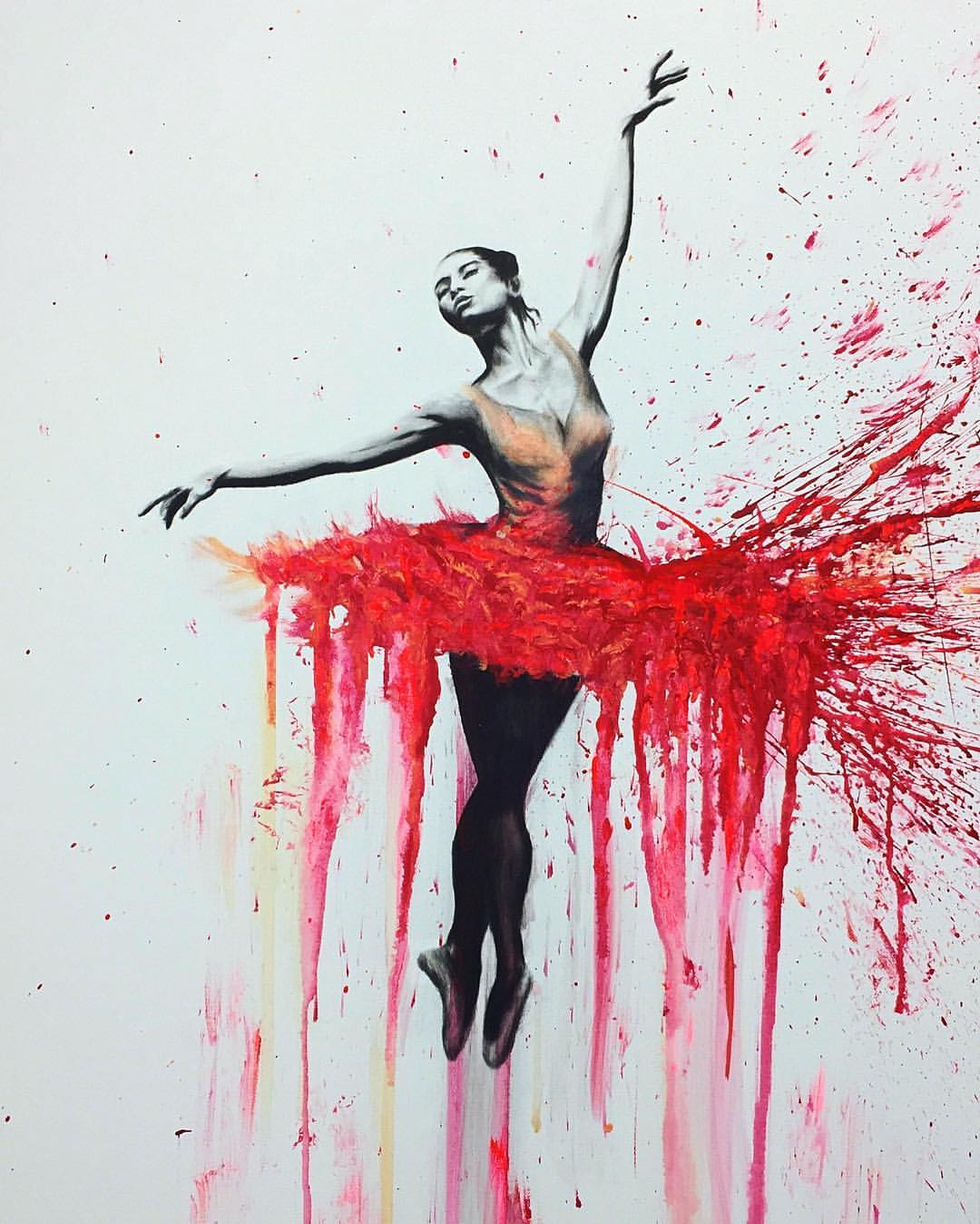
So I went down to my under-house garage with a charcoal stick, a brush, and some red paint.
I began drawing/brush painting the most realistic ballerina I could at the time. The charcoal formed the whole body and side profile of her face, and I thinned acrylic paint to create a soft, almost watercolour effect for the dress.
Then the mistake happened.
The red paint spilled- It splashed across the dress and legs.
In that moment I felt the artwork was ruined. Hours of careful work—gone. I had created something I actually liked, something I was proud of and also believed I could sell for my usual $99.
Frustrated, I turned the music up loud—heavy metal this time—mixed some deeper red tones, and simply let go.
Emotion took over… Movement replaced control.
What began as a realistic drawing transformed into something else entirely. It became a reflection not just of what I saw, but of what I felt. The music, the movement of the ballet, the frustration of the mistake—all of it poured into the work.
The piece had no clear moment of completion. No defined ending. Eventually I just felt it was time to drop the brushes and stop.
I stepped back, looked at it, and thought:
“This sucks.”
Such, a similar feeling is still familiar today with some works.
The rush during creation can be incredible, but the moment after can be filled with doubt. Balancing realism with raw expression is a constant tension.
I actually planned to destroy the piece. It felt too chaotic, too raw, too different from what I thought was “good art” or thought people wanted.
Thankfully, after some much needed advice from my bestie, I was convinced not to destroy the work.
So instead, I uploaded it online.
It sold within a week—and for much more than my usual $99.
That moment changed everything.
Looking back now, I often wonder:
Was it an accident? Fate? Or simply the willingness to follow something unexpected?
Maybe discoveries don’t come from perfect planning. Maybe they come from mistakes—if we’re willing to explore them.
Sometimes the best thing an artist can do is let the heart, mind, and soul take over… and see where it leads.
In that sense, I’m glad I’m clumsy.
Take care,
Ashvin Harrison